Materials · before you buy · ages 2–4
Before you buy another activity, look around your house first.
Match the action, not the product.
Most shelves do not need another material. They need the one action your child keeps repeating to have a safe, ordinary place to happen. Below is the whole method, six complete swaps you can set up today, and the five questions worth asking before any purchase.
The rule
A swap is not a replica of a classroom material.
It is a safe, ordinary household object that supports the action you keep noticing — offered before you buy a dedicated activity.
- 1Notice the action.
- 2Try a safe household version.
- 3Show the first step.
- 4Step back.
- 5Watch what happens.
Pour
Use a small household setup.
Open + close
Offer simple containers.
Carry
Give movement a useful job.
Wipe
Use real cleaning tools.
Sort
Match ordinary objects.
Real life
Move the action into the home.
Six sample swaps
One for each action, with how to set it up
These six are yours whether you buy anything or not. Each is an ordinary object matched to something you have already seen your child do more than once.
If they keep pouring
Instead of
A dedicated pouring pitcher
Use what you have
a small, lightweight household pitcher
How to offer it. Fill it a third full, set two sturdy cups on a shallow tray, and put a small dishcloth beside it. Pour once yourself, slowly, then step back.
3 more swaps for this action are in the companion guide.
If they keep opening + closing
Instead of
A dedicated opening work
Use what you have
a lunch container
How to offer it. Offer one closure at a time. Open and close it once, hand it over, and leave it on a low shelf so they can return to it without asking.
4 more swaps for this action are in the companion guide.
If they keep carrying + moving
Instead of
A dedicated carrying basket
Use what you have
a small laundry basket
How to offer it. Put two or three folded towels in it and give the trip a destination — from the dryer to the bedroom. The job has to actually need doing.
3 more swaps for this action are in the companion guide.
If they keep wiping + cleaning
Instead of
A wiping cloth activity
Use what you have
a small washcloth
How to offer it. Wring it out before you hand it over so it is damp, not dripping. Wipe one small surface yourself, then let them finish the rest.
5 more swaps for this action are in the companion guide.
If they keep sorting + matching
Instead of
A matching work
Use what you have
sock pairs
How to offer it. Start with four obvious pairs, not the whole basket. Match one pair while they watch, then leave the rest and say nothing.
4 more swaps for this action are in the companion guide.
If the action already happens in real life
Instead of
Turning the interest into a tray
Use what you have
the job itself
How to offer it. Washing produce, carrying napkins to the table, watering a plant. Give the real version, at their height, with one step shown.
3 more swaps for this action are in the companion guide.
You now have 6 of 24. The other 22 are the ones parents ask about most.
Use What You Have: 24 Montessori-at-Home Swaps is nine printable pages: all 24 swaps grouped by action, and for each one how to set it up, what to show or say first, what going well actually looks like, and when to stop offering it.
$7 — less than one wooden activity you might have bought this week.
It is the companion to the 7-Day Montessori Reset, added at checkout with a single checkbox. 30-day money-back guarantee, both included.
See the 7-Day Montessori ResetA real page
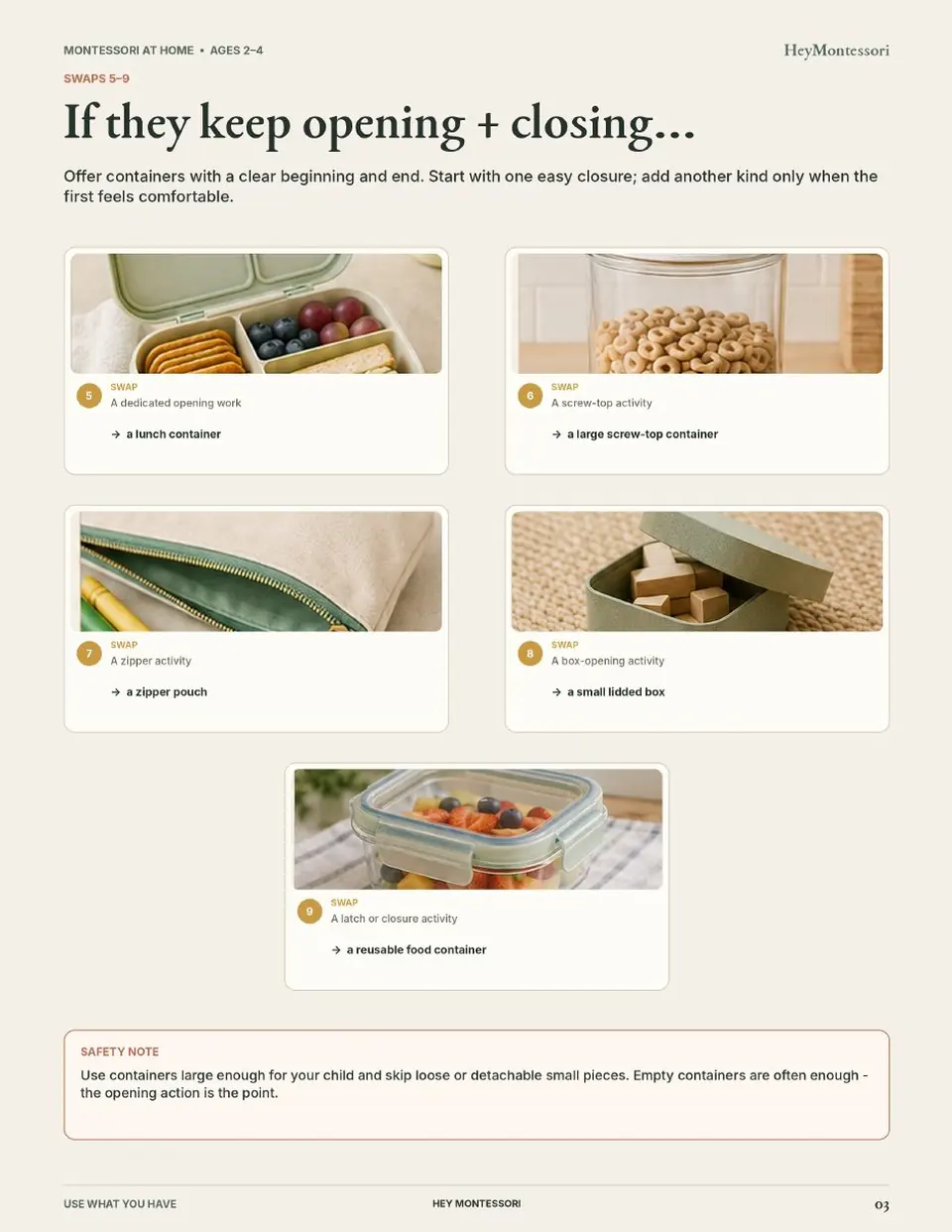
This is one page of nine.
Not a mockup — an actual page from the companion guide. The other eight look like this.
Real life counts
Sometimes the best activity isn't an activity.
Once you notice the action, look for a safe place it already matters in family life. You do not need to turn every interest into a tray.
Kitchen
Wash produce, carry napkins, stir with a safe utensil, pour water.
Table
Place napkins, carry safe dishes, wipe afterward.
Laundry
Move clothes, pair socks, carry towels.
Entryway
Put shoes in the basket, hang low items.
Plants
Carry the watering can, water, wipe spills.
Pick one action you saw more than once this week and ask where it already happens in your home. Then offer one real, safe way to take part. Participation is the point, not a perfect performance.
The decision card
Before you buy another activity…
Five questions, free, and worth keeping on the fridge.
- 1What action am I seeing repeatedly?
- 2Do we already own something safe that supports it?
- 3Could they do this in real family life instead?
- 4Is the issue the material — or how it is being offered?
- 5What would buying this solve that we cannot reasonably solve already?
Buy when…
The new material solves a specific limitation you have actually observed.
Wait when…
You are mostly hoping something new will finally create interest.
Observe → use what you have → buy with a reason.
Inside the companion
Nine photographed pages
Real pages, so you can see the format before it is ever added to an order.
Nine pages · printable or read on your phone · added to the Reset at checkout.
Safety first
Use only items that fit your child and your home, and supervise as appropriate. Avoid choking hazards, hot or sharp items, breakables, cleaning chemicals and unsafe water access. Water only, unless a product is specifically safe for a child to help with.
Looking for what is worth owning by age? Browse the materials hub.