Montessori at home · Ages 2–4
Your child isn't engaging with what you've set up. Don't add more yet.
Start tonight in 15 minutes. Then use a simple seven-day process to decide what to keep, simplify, model, move, or leave alone.
- Instant download
- One-time $39 — tax included
- Refundable for 30 days
Grounded in Montessori observation and prepared-environment principles. Sources and safety notes included.
Sound familiar?
You set it up carefully. They walked past it.
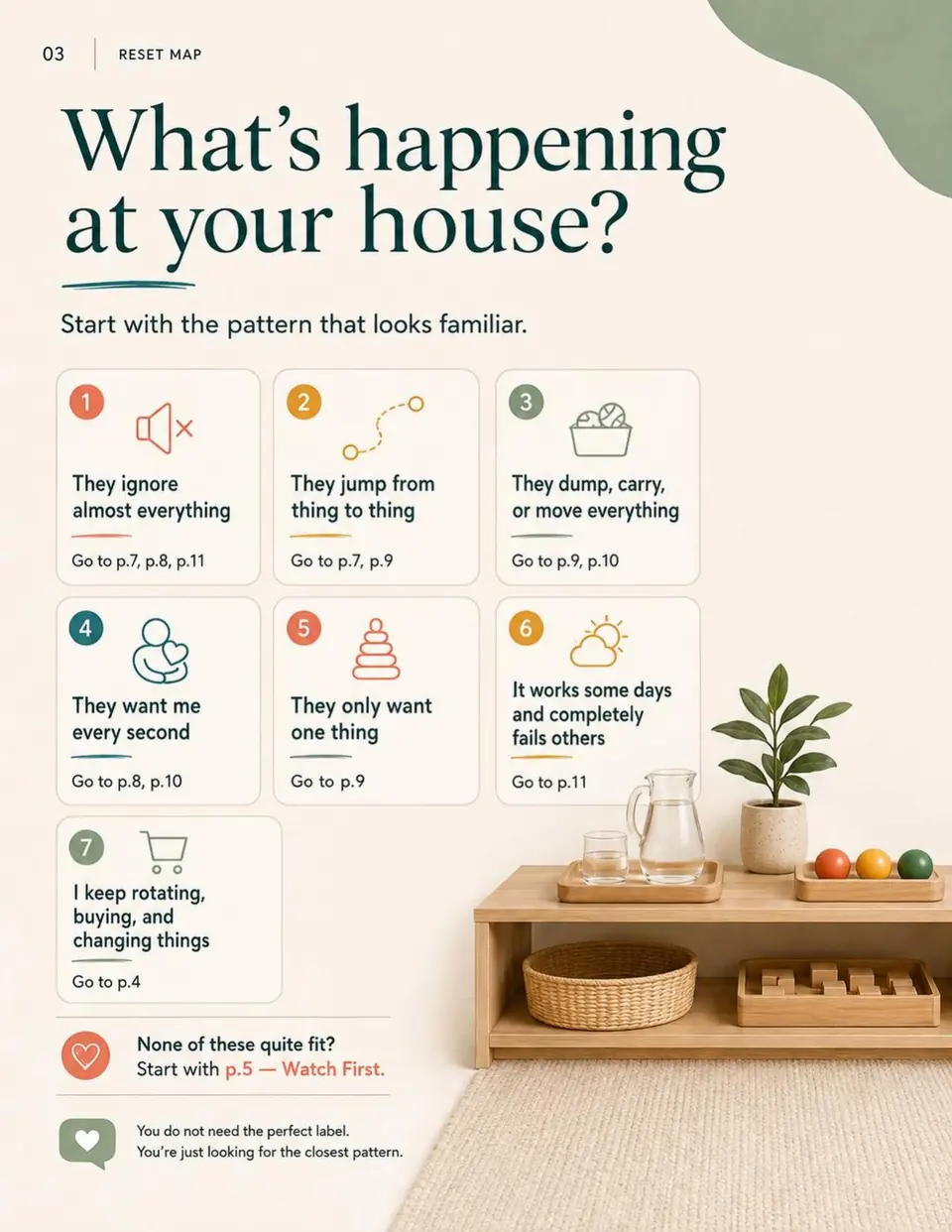
One of these is usually the week you're having.
- They ignore almost everything on the shelf.
- They jump from one thing to the next.
- They dump and carry things instead of using them.
- They want you every second.
- They repeat the same one thing endlessly.
- Some days it works, and other days nothing does.
Those patterns don't tell you what the problem is. That's why the Reset starts with observation instead of a label.
The method
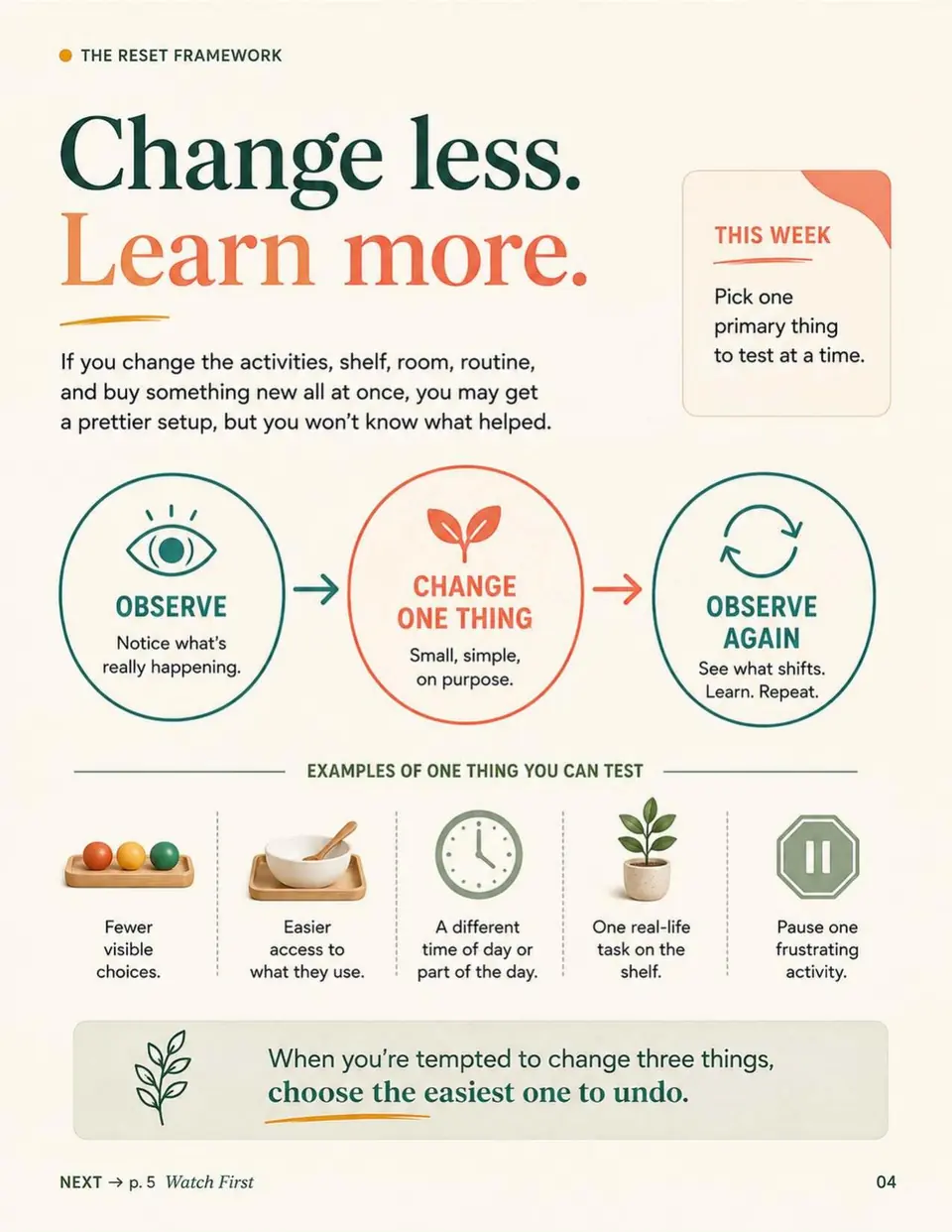
Change less. Learn more.
Observe
Watch what actually happens, without fixing it yet.
Change one thing
One variable, so the result means something.
Observe again
Now you know whether that change helped.
Seven days of noticing what your child chooses, ignores, repeats, struggles with and does naturally in real life — so the next decision is informed instead of hopeful.
Who made this. The Reset is written by the HeyMontessori editorial team — the same people who write and review the free activity, material and home records on this site. Every page is checked against established Montessori practice rather than personal opinion, and we say plainly when something is a judgement call instead of a rule.
Inside the guide
See exactly what you're getting
This isn't another list of activity ideas. It's a 20-page visual decision guide you can actually use while you watch what happens at home.
A practical field guide · seven days · printable or read on your phone · instant download.
What it's built on
- Observation before intervention
- A prepared environment the child can use
- Practical life as real work
- One change at a time
What you get
- 20-page illustrated decision guide
- Instant PDF — read on your phone or print
- One-time purchase, yours to keep
- 30-day money-back guarantee
$39
One-time · tax included
Secure checkout by Paddle. Nothing added at checkout.
What you'll actually do
One small job a day
Each day takes minutes of attention, not an evening of preparation.
- Day 1Notice what they chooseWrite down what they go to, without changing anything.
- Day 2Simplify what's visibleFewer choices, more clearly presented. Nothing new added.
- Day 3Remove one bit of frictionThe lid, the height, the tray, the distance to the sink.
- Day 4Follow the repetitionNotice the actions they return to. Repetition is useful information.
- Day 5Notice the real workLaundry, food, sweeping. Real life counts as the work.
- Day 6Find the windowThe time of day and the context where they concentrate.
- Day 7Make one next decisionKeep, pause, simplify, repeat or change. One decision only.
Why it isn't a declutter checklist
The same process gives different answers
Sometimes the shelf really is part of the problem.
Several activities are visible, including duplicates and a few that haven't been chosen. The parent removes the obvious low-use and duplicate choices, then watches again. Now it's easier to see what the child returns to — and what they consistently skip.
Sometimes the shelf isn't the problem at all.
The shelf is fine. The child is hungry at 4pm, the room is loud, and every session gets interrupted. Nothing on the shelf needed changing; the time of day did.
What progress can look like
The goal isn't to manufacture a perfect Montessori week. It's to stop guessing.
By the end of seven days, you may have noticed:
- Which choices they return to.
- Where one point of friction is getting in the way.
- Whether fewer choices make the space easier to use.
- Where real-life participation works better than another prepared activity.
- What you can stop buying, rotating, or fixing.
- And most importantly, what to test next.
The 7-Day Montessori Reset
$39
One-time purchase · tax included
20 pages. Reads in one sitting, run over a week.
A PDF you can read on your phone or print. Yours to keep.
At checkout you can add Use What You Have — 24 household swaps — for $7. See a sample swap and what's inside.
- Instant download
- One-time $39 — tax included
- Refundable for 30 days
Questions
Before you buy
- Is this a set of activities?
- No. It is a decision process. Activities are the easy part to find — knowing which change is worth making is the hard part, and that is what these seven days give you.
- Who is this for?
- The Reset is designed primarily for families with children roughly 2–4 who are already trying Montessori or Montessori-inspired learning at home. It doesn't use rigid age milestones; it teaches you what to observe in your own home.
- Do I need Montessori materials?
- No. Most of the week is about what you already own, where it sits, and when your child actually settles. Buying is the last resort, not the first step.
- How do I get it?
- Instantly, as a PDF you can read on a phone or print. No account to create; you get a link you can come back to.
- What if it isn't for me?
- Ask for a refund within 30 days and you get your money back. Our payments are handled by Paddle, who process refunds on our behalf.
- Is this developmental advice?
- No. It is practical educational guidance about observing and preparing a home. It is not a diagnosis, an assessment or therapeutic advice.
Read our refund policy and terms.